
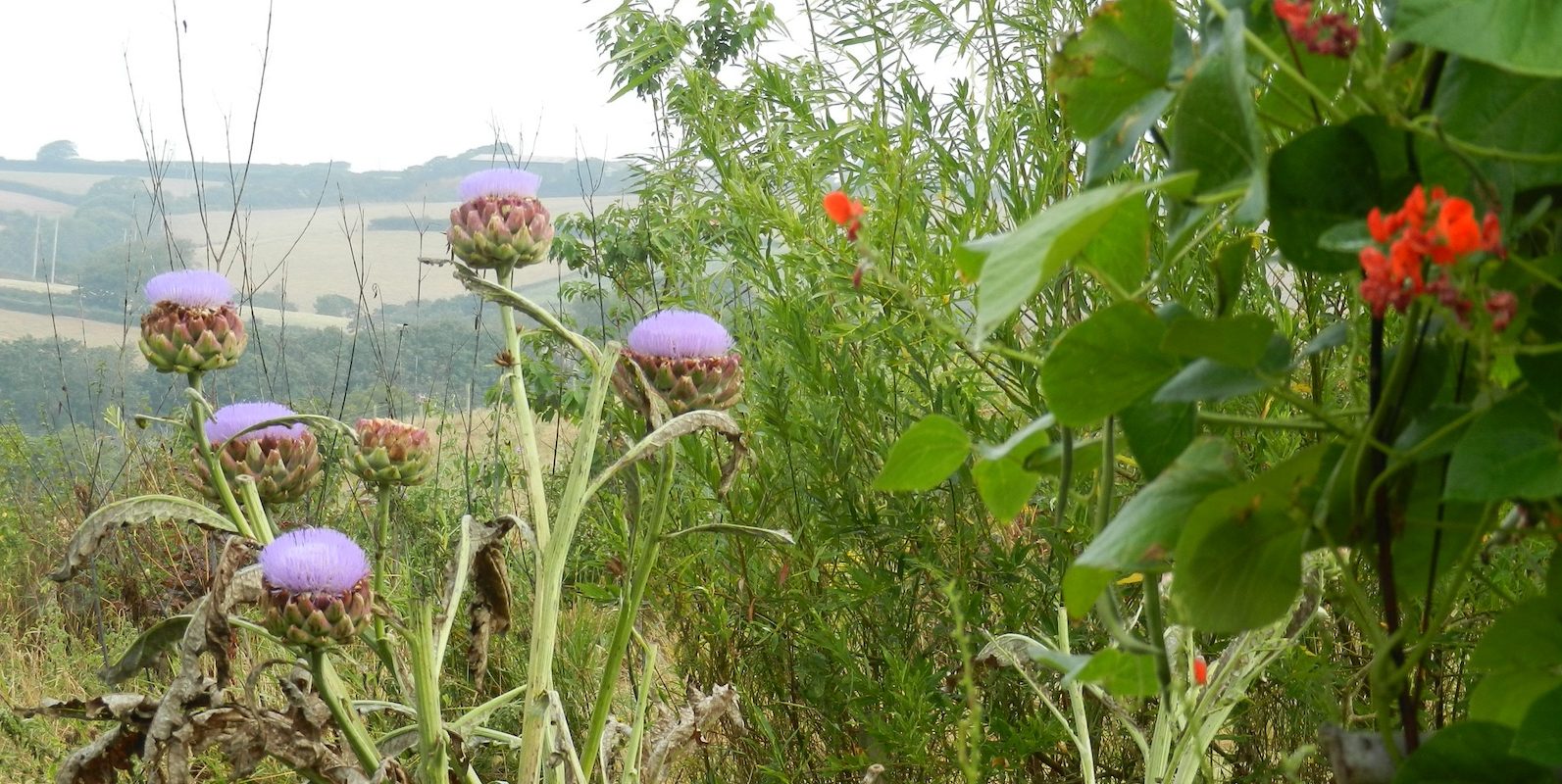
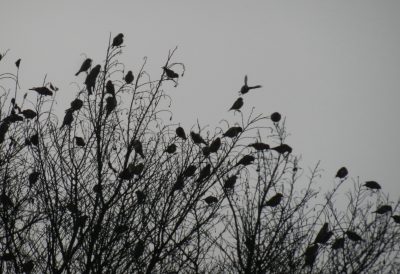
This is the month in which nature hovers between the two seasons of Summer and Autumn, in a state of suspension as it moves towards the Equinox on the 23rd of September. The Berries are bursting forth from the trees, giving plenty of food and nutrients for the bird population – many of whom will be undertaking long journeys of Summer migration. The House Martins are flying off to the south and the Blackcaps are flying in and already being identified from their singing. A range of sights greet us; there all sorts of mushrooms emerging from the damper undergrowth, misty and cold mornings, rain, sun and long shadows, Artichokes going to flowers, and daily charms of Goldfinch creating their own small murmurations. And in the early hours on a silent, misty morning, the Heron flew up through the trees and away down the river. Perfect.
We had plenty of warm, even hot, sunny days which resulted in yet another record high – the 3rd warmest September since records began. There were also a few very cold nights, reminding us that the time of warmth was waning and that our days basking in the sun would soon end. The two seasons were on display all around us. Everywhere was abundance and yet the fields were also full of decaying thistles and dried seedheads. The Chestnut tree gave us a magnificent display of fruits, which were then scattered on the ground, promptly eaten, leaving only empty shells. I have never seen a squirrel in this field and have no idea which animal comes to gorge on these delights.
I decided to investigate as to what might be eating the nuts of the Chestnut tree. As usual, there was an enormous amount of information regarding this tree, its history and its many uses and I ended up far away from my original pursuit. Confusion exists about the introduction of the tree. H. Godwin (History of the British Flora – 1956) and Oliver Rackham (Ancient Woodland – 1980), both promote the story of the Sweet Chestnut being brought to England by the Romans. For the most part they have based their assumptions on the earlier writings of three men and one woman. John Evelyn in his 1706 edition of ‘Sylva – A Discourse of Forest Trees’. Andrew Coltee Ducarel in his 1771 paper on the indigenous status and history of the Chestnut Tree in England. And finally Clement and Eleanor Mary Reid in their book of ‘The Origin of British Flora’, published in 1889. All of the above endorsed the idea of the Roman introduction but, fast forward to 2019 and the University of Gloucestershire and Historic England have found no evidence of this claim. They can find no record of any pollen or DNA before 1640 in any of the most recent archeological research (archeology.co.uk). Who knew they were even trying to find out about the beginnings of this ‘non native’ tree’?
However, just to set the cat amongst the pigeons, John Gerard, the herbalist wrote about this tree – in 1597.
“The Chestnut tree is a very great and high tree: it casteth forth very many boughs: the body is thick, and sometimes of so great a compass as that two men can hardly fathom it: the timber or substance of the wood is sound and durable: the leaves be great, rough, wrinkled, nicked in the edges, and greater than the particular leaves of the Walnut tree. The blowings or catkins be slender, long, and green: the fruit is enclosed in round a rough and prickly husk like to an hedgehog or urchin, which opening itself doth let fall the ripe fruit or nut. This nut is not round, but flat on the one side, smooth, and sharp pointed: it is covered with a hard shell, which is tough and very smooth, of a dark brown colour: the meat or inner substance of the nut is hard and white, and covered with a thin skin which is under the shell.”
That’s a pretty good description of a tree that is not supposed to have existed at the time of his writings. More myths and dates emerged as I read on, but that’s enough of that for now. It is described as a non native that has become naturalised. And a good job too, as it brings benefits all round. It’s an important source of nectar and pollen for bees and other insects, and a large number of micro moths feed on the leaves and nuts. It was used down in the coal mines as pit props, which gives you some idea as to its strength. It was also used as poles for growing hop vines, for fencing, for furniture, fuel, charcoal and casks for wines and spirits. I could go on, (even more than I already have), but other species of importance are calling to me.
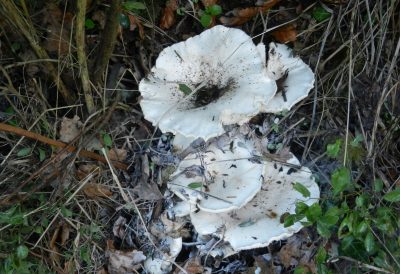
A quick mention of the Fungi which have been popping up in various places; open fields, hedgerows, on dead wood and on the pile of wood chips. Identification has proved to be a nightmare. We definitely have Puffballs and Earthballs and there were good examples of Giant Funnel and Fleecy Milkcap. However, some bright orange inhabitants on the dead wood were hard to place – the closest lookalike I found was the Orange Poreconch, originally from Madagascar, (and now considered an invasive species), arriving in Britain in 2012. I remain slightly dubious about my identifications skills – the book on Fungi has yet to be bought.